Introduction
Timber is one of the oldest and most widely used construction materials in civil engineering. It is obtained from trees and is used in doors, windows, roofs, furniture, formwork, and various structural applications. Due to its strength, durability, and workability, timber remains an important material in modern construction.
What is Timber?
Timber is wood that has been processed and made suitable for construction purposes. It is obtained from mature trees and used for structural and non-structural works because of its strength and durability.
Types of Timber
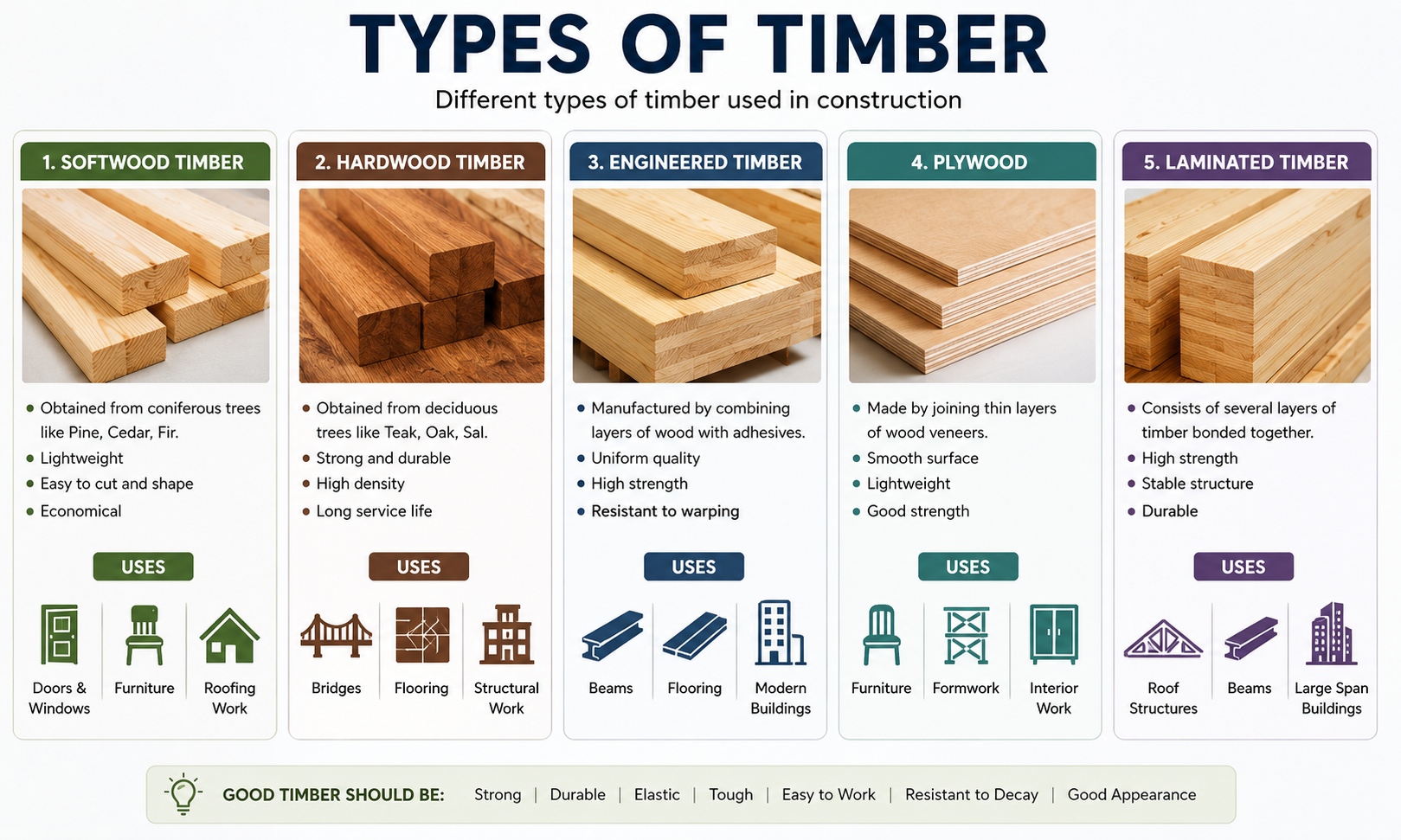
1. Softwood Timber
Softwood timber is obtained from coniferous trees such as pine and cedar.
Features:
- Lightweight
- Easy to cut and shape
- Economical
Uses:
- Doors and windows
- Furniture
- Roofing work
2. Hardwood Timber
Hardwood timber is obtained from deciduous trees such as teak and oak.
Features:
- Strong and durable
- High density
- Long service life
Uses:
- Bridges
- Flooring
- Structural work
3. Engineered Timber
Engineered timber is manufactured by combining layers of wood with adhesives.
Features:
- Uniform quality
- High strength
- Resistant to warping
Uses:
- Beams
- Flooring
- Modern buildings
4. Plywood
Plywood is made by joining thin layers of wood veneers together.
Features:
- Smooth surface
- Lightweight
- Good strength
Uses:
- Furniture
- Formwork
- Interior work
5. Laminated Timber
Laminated timber consists of several layers of timber bonded together.
Features:
- High strength
- Stable structure
- Durable
Uses:
- Roof structures
- Beams
- Large-span buildings
Properties of Good Timber
A good quality timber should possess the following properties:
- High strength
- Durability
- Elasticity
- Toughness
- Workability
- Resistance to decay
- Good appearance
Advantages of Timber
- Lightweight material
- Easy to work with
- Environment friendly
- Good thermal insulation
- Attractive appearance
- Renewable resource
Uses of Timber in Construction
Timber is commonly used in:
- Doors and windows
- Roof trusses
- Furniture
- Flooring
- Formwork
- Scaffolding
- Interior decoration
Difference Between Timber and Wood
| Timber | Wood |
|---|---|
| Processed for construction use | Natural material obtained from trees |
| Ready for structural applications | Raw form of material |
| High durability | Requires further processing |
| Used in buildings and furniture | Used to manufacture timber |
Conclusion
Timber is an important construction material used in civil engineering. Due to its strength, durability, and ease of workability, it is widely used in buildings, furniture, and structural works.
Related Posts:
सिविल इंजीनियरिंग में टिम्बर क्या है?
टिम्बर वह लकड़ी है जिसे निर्माण कार्यों के लिए उपयुक्त बनाया जाता है। इसका उपयोग भवन निर्माण, दरवाजे, खिड़कियां, छत, फर्नीचर तथा अन्य संरचनात्मक कार्यों में किया जाता है।
टिम्बर के प्रकार
1. Softwood Timber
शंकुधारी वृक्षों (Coniferous Trees) से प्राप्त लकड़ी।
विशेषताएँ:
- हल्की
- आसानी से काटी जा सकती है
- किफायती
उपयोग:
- दरवाजे और खिड़कियां
- फर्नीचर
- छत का कार्य
2. Hardwood Timber
पर्णपाती वृक्षों (Deciduous Trees) से प्राप्त मजबूत लकड़ी।
विशेषताएँ:
- मजबूत और टिकाऊ
- अधिक घनत्व
- लंबी आयु
उपयोग:
- पुल
- फर्श
- संरचनात्मक कार्य
3. Engineered Timber
लकड़ी की परतों को जोड़कर निर्मित टिम्बर।
विशेषताएँ:
- समान गुणवत्ता
- अधिक शक्ति
- विकृति प्रतिरोधी
उपयोग:
- बीम
- फर्श
- आधुनिक भवन
4. Plywood
पतली लकड़ी की परतों को जोड़कर बनाई गई सामग्री।
विशेषताएँ:
- चिकनी सतह
- हल्की
- मजबूत
उपयोग:
- फर्नीचर
- फॉर्मवर्क
- आंतरिक सजावट
5. Laminated Timber
लकड़ी की कई परतों को जोड़कर तैयार किया गया टिम्बर।
विशेषताएँ:
- अधिक शक्ति
- स्थिर संरचना
- टिकाऊ
उपयोग:
- छत संरचनाएँ
- बीम
- बड़े स्पैन वाले भवन
अच्छे टिम्बर के गुण
- अधिक शक्ति
- टिकाऊपन
- लोच
- कठोरता
- कार्य करने में सरल
- सड़न प्रतिरोधी
- आकर्षक रूप
टिम्बर के लाभ
- हल्का पदार्थ
- पर्यावरण के अनुकूल
- आसानी से उपयोग योग्य
- अच्छा तापीय इन्सुलेशन
- आकर्षक स्वरूप
- नवीकरणीय संसाधन
निर्माण कार्यों में टिम्बर के उपयोग
- दरवाजे और खिड़कियां
- छत संरचनाएँ
- फर्नीचर
- फर्श
- फॉर्मवर्क
- मचान (Scaffolding)
- आंतरिक सजावट
टिम्बर और लकड़ी में अंतर
| टिम्बर | लकड़ी |
|---|---|
| निर्माण कार्य के लिए तैयार | प्राकृतिक रूप में प्राप्त |
| प्रसंस्कृत सामग्री | कच्ची सामग्री |
| अधिक टिकाऊ | आगे प्रसंस्करण की आवश्यकता |
| भवन निर्माण में उपयोग | टिम्बर बनाने के लिए उपयोग |
निष्कर्ष
टिम्बर सिविल इंजीनियरिंग में उपयोग की जाने वाली एक महत्वपूर्ण निर्माण सामग्री है। इसकी मजबूती, टिकाऊपन और आसानी से कार्य करने की क्षमता के कारण इसका उपयोग भवन निर्माण तथा अन्य संरचनात्मक कार्यों में व्यापक रूप से किया जाता है।
संबंधित पोस्ट:
© CiviGlobe. All Rights Reserved.
Empowering Civil Engineering Students Worldwide