Introduction
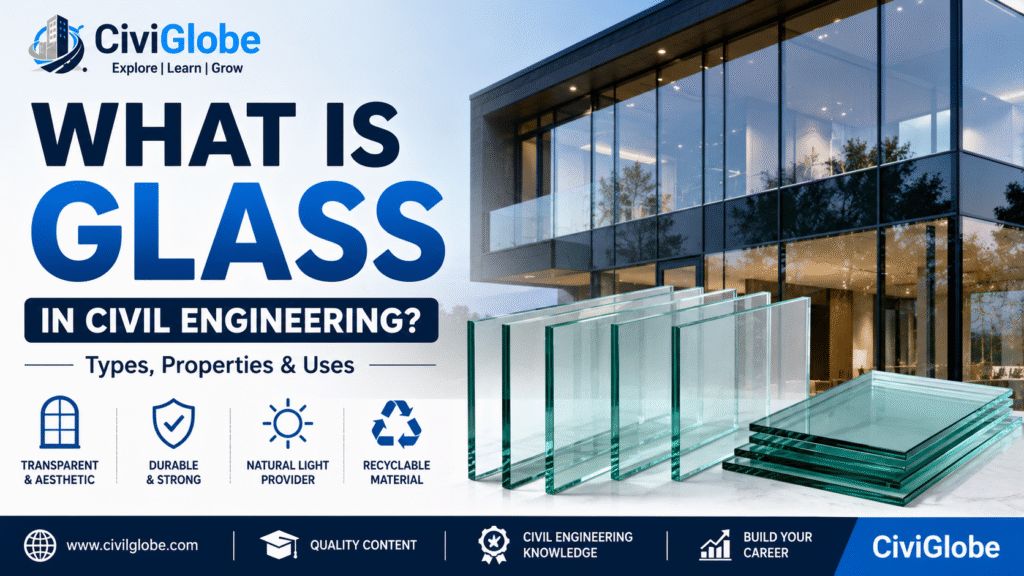
Glass is one of the most important construction materials used in modern buildings and structures. Due to its transparency, durability, and aesthetic appearance, glass is widely used in windows, doors, facades, skylights, and interior decoration. It enhances natural lighting and improves the overall appearance of buildings.
What is Glass?
Glass is a hard, transparent, and brittle material manufactured by melting silica (sand), soda ash, and lime at high temperatures. It is widely used in civil engineering and construction because of its strength, durability, and attractive appearance.
Types of Glass
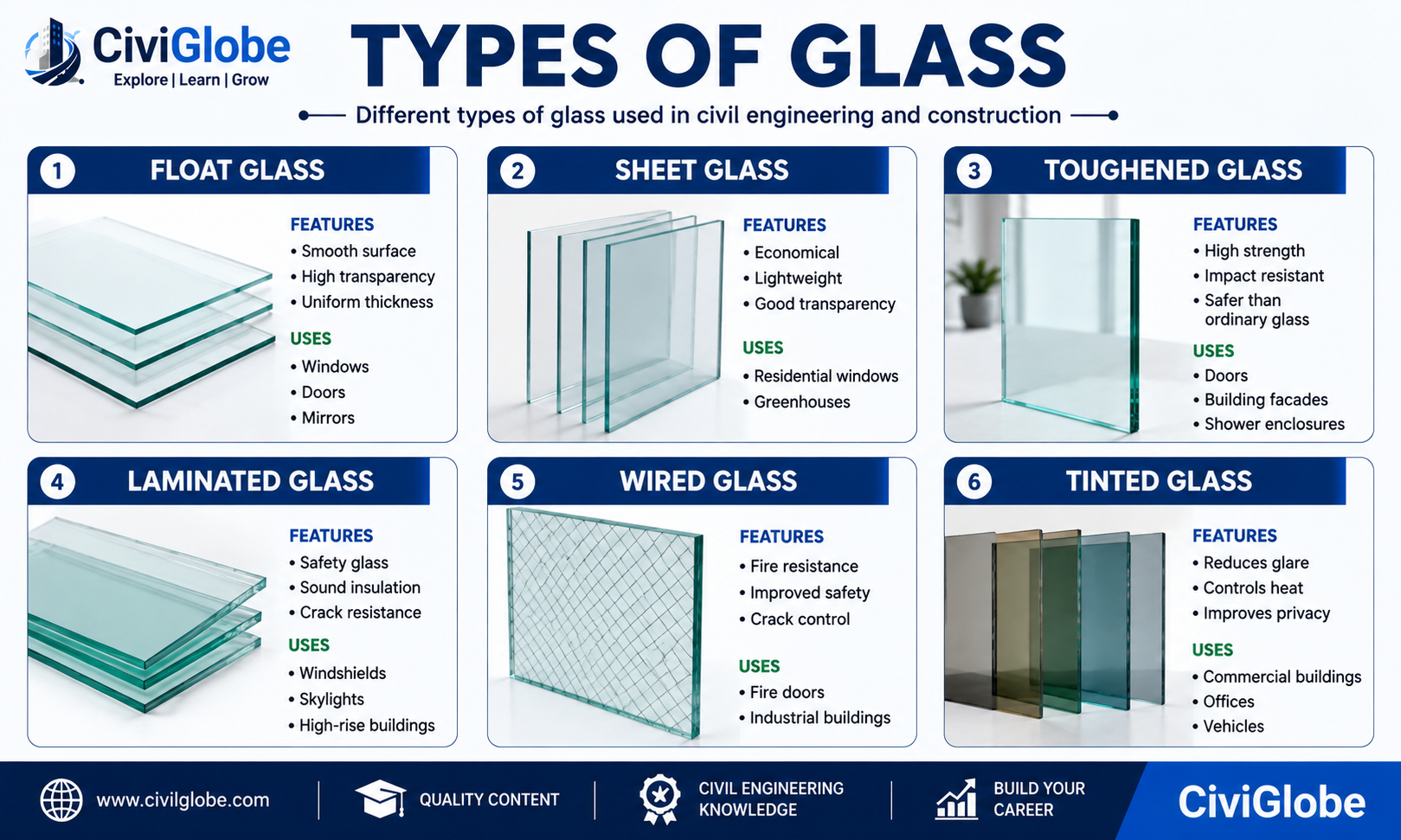
1. Float Glass
Float glass is a smooth and transparent glass produced by floating molten glass on molten tin.
Features:
- Smooth surface
- High transparency
- Uniform thickness
Uses:
- Windows
- Doors
- Mirrors
2. Sheet Glass
Sheet glass is manufactured by drawing molten glass into sheets.
Features:
- Economical
- Lightweight
- Good transparency
Uses:
- Residential windows
- Greenhouses
3. Toughened Glass
Toughened glass is heat-treated to improve its strength and safety.
Features:
- High strength
- Impact resistant
- Safer than ordinary glass
Uses:
- Doors
- Building facades
- Shower enclosures
4. Laminated Glass
Laminated glass consists of two or more layers bonded together with a plastic interlayer.
Features:
- Safety glass
- Sound insulation
- Crack resistance
Uses:
- Windshields
- Skylights
- High-rise buildings
5. Wired Glass
Wired glass contains a wire mesh embedded inside the glass.
Features:
- Fire resistance
- Improved safety
- Crack control
Uses:
- Fire doors
- Industrial buildings
6. Tinted Glass
Tinted glass contains coloring agents to reduce sunlight and heat.
Features:
- Reduces glare
- Controls heat
- Improves privacy
Uses:
- Commercial buildings
- Offices
- Vehicles
Properties of Glass
A good quality glass should possess the following properties:
- Transparent and smooth surface
- Hard and durable
- Weather resistant
- Impermeable to water
- Good electrical insulator
- Resistant to chemicals
- Can be molded into various shapes
Advantages of Glass
- Provides natural lighting
- Attractive appearance
- Resistant to corrosion
- Easy to clean
- Durable and recyclable
- Improves aesthetics
Uses of Glass in Construction
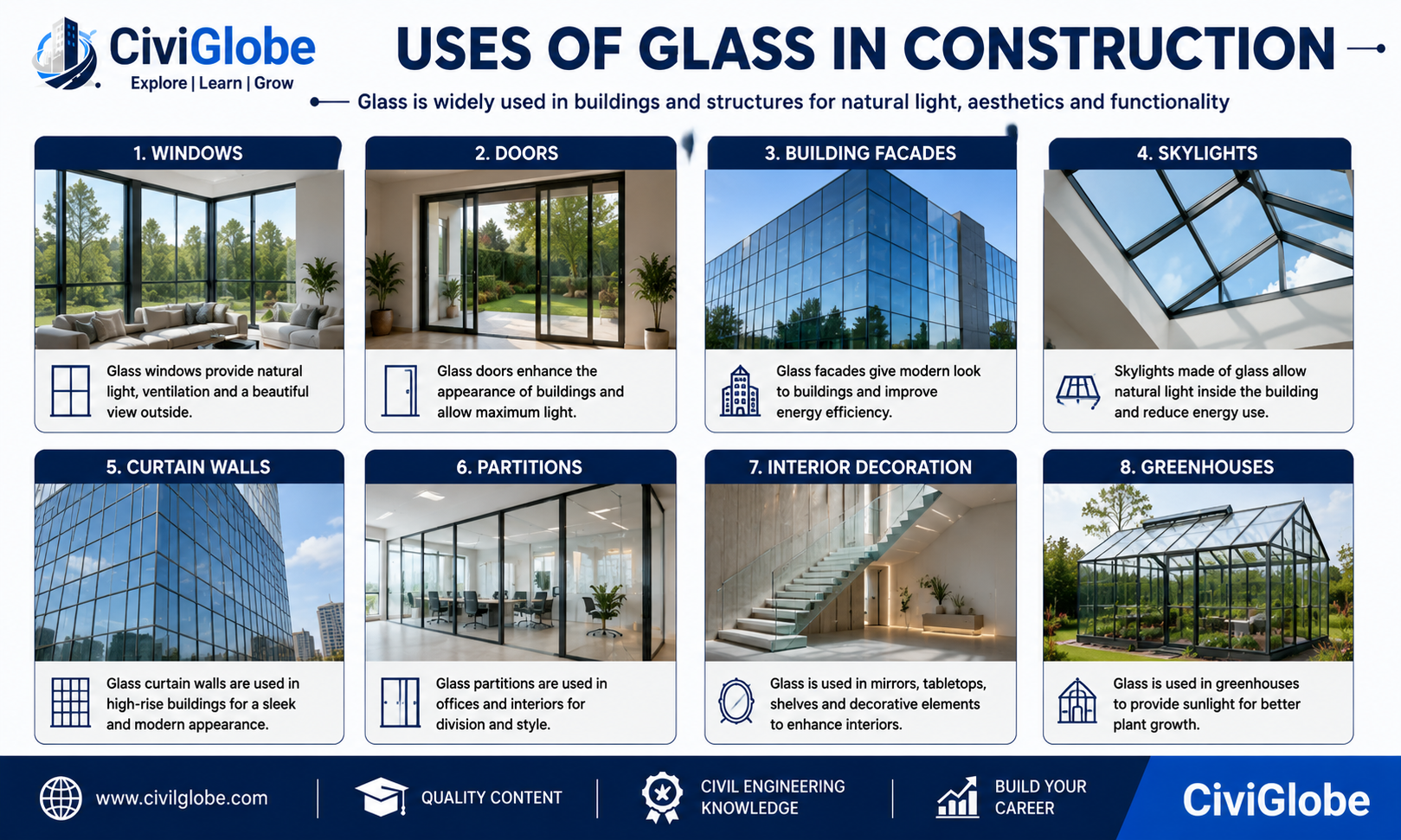
Glass is commonly used in:
- Windows
- Doors
- Building facades
- Skylights
- Interior decoration
- Curtain walls
- Greenhouses
- Partitions
Difference Between Glass and Acrylic
Glass and acrylic are both transparent materials widely used in construction and architectural applications. However, they differ in strength, weight, durability, cost, and impact resistance. The following table highlights the key differences between glass and acrylic.
| Glass | Acrylic |
|---|---|
| Made from natural raw materials such as silica sand, soda ash, and limestone. | Made from a synthetic plastic called polymethyl methacrylate (PMMA). |
| Heavier in weight. | Lightweight compared to glass. |
| More scratch-resistant. | More prone to scratches. |
| Can break into sharp pieces when impacted. | Highly impact-resistant and less likely to shatter. |
| More resistant to high temperatures. | Less heat-resistant than glass. |
| Generally more affordable for standard applications. | Usually more expensive than ordinary glass. |
| Commonly used in windows, doors, facades, and curtain walls. | Commonly used for skylights, signboards, partitions, protective barriers, and decorative applications. |
Both glass and acrylic have their own advantages. Glass is preferred for its durability, scratch resistance, and heat resistance, while acrylic is chosen for its lightweight nature and excellent impact resistance. The best choice depends on the specific construction application.
Conclusion
Glass is an important construction material widely used in modern buildings due to its transparency, durability, and aesthetic appearance. Different types of glass are used for various applications such as windows, doors, facades, and skylights, making it an essential material in civil engineering.
Frequently Asked Questions (FAQ)
What is Glass?
Glass is a hard and transparent material made from silica, soda ash, and lime, commonly used in construction.
What are the Types of Glass?
The main types of glass are Float Glass, Sheet Glass, Toughened Glass, Laminated Glass, Wired Glass, and Tinted Glass.
What are the Uses of Glass?
Glass is used in windows, doors, facades, skylights, partitions, and interior decoration.
Why is Glass Used in Buildings?
Glass provides natural light, improves aesthetics, and enhances the appearance of structures.
ग्लास क्या है?
ग्लास एक कठोर, पारदर्शी और भंगुर पदार्थ है, जिसे सिलिका (रेत), सोडा ऐश और चूने को उच्च तापमान पर पिघलाकर बनाया जाता है। इसका उपयोग आधुनिक भवनों में खिड़कियों, दरवाजों, स्काइलाइट, फसाड और आंतरिक सजावट में किया जाता है।
ग्लास के प्रकार
1. फ्लोट ग्लास
विशेषताएँ:
- चिकनी सतह
- अधिक पारदर्शिता
- समान मोटाई
उपयोग:
- खिड़कियाँ
- दरवाजे
- दर्पण
2. शीट ग्लास
विशेषताएँ:
- किफायती
- हल्का
- अच्छी पारदर्शिता
उपयोग:
- आवासीय भवन
- ग्रीनहाउस
3. टफन्ड ग्लास
विशेषताएँ:
- अधिक मजबूती
- आघात प्रतिरोधी
- सुरक्षित
उपयोग:
- दरवाजे
- भवनों के फसाड
- शॉवर एन्क्लोजर
4. लैमिनेटेड ग्लास
विशेषताएँ:
- सुरक्षा प्रदान करता है
- ध्वनि अवरोधक
- दरारों के प्रति प्रतिरोधी
उपयोग:
- विंडशील्ड
- स्काइलाइट
- ऊँची इमारतें
5. वायरड ग्लास
विशेषताएँ:
- अग्निरोधी
- अधिक सुरक्षित
- दरार नियंत्रण
उपयोग:
- फायर डोर
- औद्योगिक भवन
6. टिंटेड ग्लास
विशेषताएँ:
- चकाचौंध कम करता है
- गर्मी कम करता है
- गोपनीयता बढ़ाता है
उपयोग:
- कार्यालय
- वाणिज्यिक भवन
- वाहन
ग्लास के गुण
- पारदर्शी
- टिकाऊ
- जलरोधी
- रासायनिक प्रतिरोधी
- विद्युत कुचालक
- विभिन्न आकारों में ढाला जा सकता है
ग्लास के लाभ
- प्राकृतिक प्रकाश प्रदान करता है
- आकर्षक दिखता है
- साफ करना आसान है
- पुनर्चक्रण योग्य है
- टिकाऊ है
निर्माण कार्यों में ग्लास के उपयोग
- खिड़कियाँ
- दरवाजे
- फसाड
- स्काइलाइट
- आंतरिक सजावट
- पार्टिशन
ग्लास और ऐक्रेलिक में अंतर
ग्लास और ऐक्रेलिक दोनों ही पारदर्शी (Transparent) सामग्री हैं जिनका उपयोग निर्माण और वास्तुकला (Construction & Architecture) में किया जाता है। हालांकि, दोनों के वजन, मजबूती, टिकाऊपन, लागत और प्रभाव प्रतिरोध (Impact Resistance) में महत्वपूर्ण अंतर होता है। नीचे दी गई तालिका इनके मुख्य अंतर को दर्शाती है।
| ग्लास (Glass) | ऐक्रेलिक (Acrylic) |
|---|---|
| सिलिका रेत, सोडा ऐश और चूना पत्थर जैसे प्राकृतिक कच्चे पदार्थों से बनाया जाता है। | पॉलीमेथिल मेथाक्रिलेट (PMMA) नामक सिंथेटिक प्लास्टिक से बनाया जाता है। |
| वजन में भारी होता है। | ग्लास की तुलना में हल्का होता है। |
| खरोंच (Scratches) के प्रति अधिक प्रतिरोधी होता है। | अपेक्षाकृत आसानी से खरोंच लग सकती है। |
| तेज़ आघात लगने पर टूट सकता है और नुकीले टुकड़ों में बिखर सकता है। | अधिक प्रभाव प्रतिरोधी होता है और आसानी से नहीं टूटता। |
| उच्च तापमान को बेहतर तरीके से सहन करता है। | ग्लास की तुलना में कम ताप प्रतिरोधी होता है। |
| सामान्य उपयोग के लिए अपेक्षाकृत किफायती होता है। | सामान्य ग्लास की तुलना में अक्सर महंगा होता है। |
| खिड़कियों, दरवाजों, फसाड (Facades) और कर्टेन वॉल (Curtain Walls) में व्यापक रूप से उपयोग किया जाता है। | स्काइलाइट, साइनबोर्ड, पार्टिशन, सुरक्षा बैरियर और सजावटी कार्यों में उपयोग किया जाता है। |
ग्लास और ऐक्रेलिक दोनों के अपने-अपने फायदे हैं। ग्लास अपनी टिकाऊपन, खरोंच प्रतिरोध और ताप प्रतिरोध के कारण पसंद किया जाता है, जबकि ऐक्रेलिक अपने हल्के वजन और बेहतर प्रभाव प्रतिरोध के कारण कई विशेष अनुप्रयोगों में उपयोग किया जाता है। किसी भी सामग्री का चयन परियोजना की आवश्यकता और उपयोग के आधार पर किया जाता है।
निष्कर्ष
ग्लास आधुनिक निर्माण कार्यों में उपयोग होने वाली एक महत्वपूर्ण सामग्री है। इसकी पारदर्शिता, मजबूती और आकर्षक स्वरूप इसे भवन निर्माण में अत्यंत उपयोगी बनाते हैं।
© CiviGlobe. All Rights Reserved.
Empowering Civil Engineering Students Worldwide