Introduction
Bricks are one of the oldest and most widely used construction materials in civil engineering. They are used in walls, foundations, pavements, and various building structures.
Bricks provide strength, durability, and stability to buildings. Due to their affordability and availability, bricks remain a popular choice in construction projects worldwide.
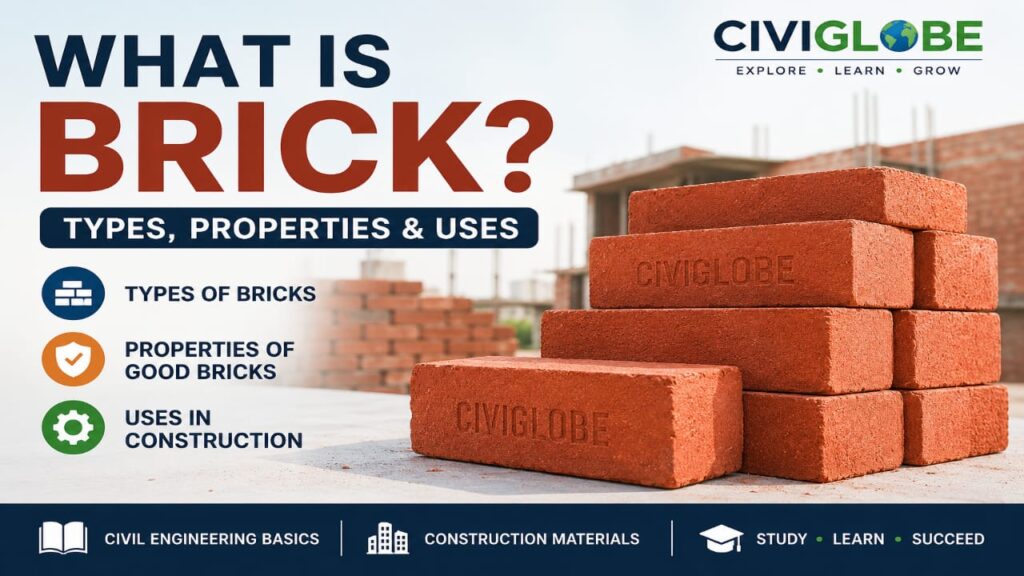
What is Brick?
A brick is a rectangular construction material made from clay, shale, concrete, fly ash, or other suitable materials. Bricks are usually molded into a standard shape and hardened by drying and burning.
They are mainly used for:
- Wall construction
- Foundations
- Partition walls
- Pavements
- Architectural works
Types of Bricks
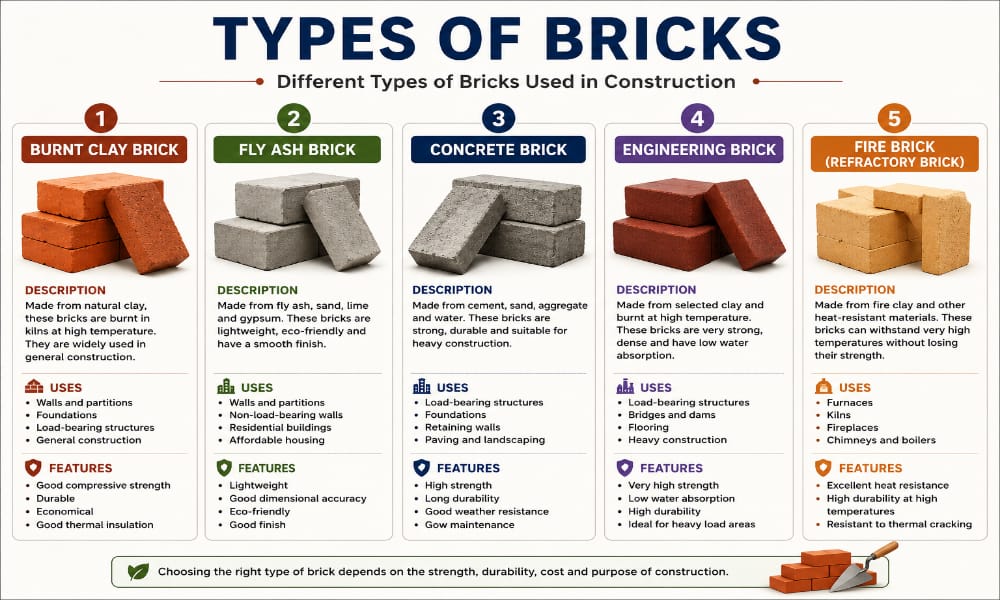
1. Burnt Clay Bricks
These are the most commonly used bricks in construction.
Features:
- Good strength
- Durable
- Economical
Uses:
- Residential buildings
- Commercial structures
- General masonry work
2. Fly Ash Bricks
Fly ash bricks are manufactured using fly ash, cement, and sand.
Features:
- Smooth surface
- Lightweight
- Eco-friendly
Uses:
- Modern buildings
- High-rise construction
- Masonry work
3. Concrete Bricks
Concrete bricks are made using cement, sand, and aggregates.
Features:
- High strength
- Durable
- Available in different sizes
Uses:
- Load-bearing walls
- Boundary walls
4. Engineering Bricks
These bricks are specially manufactured for high strength and low water absorption.
Features:
- Excellent strength
- Water resistant
Uses:
- Bridges
- Sewers
- Retaining walls
5. Fire Bricks (Refractory Brick)
Fire bricks are specially made bricks that can withstand very high temperatures.
Features:
- Heat resistant
- Durable
- High strength at high temperatures
Uses:
- Furnaces
- Kilns
- Fireplaces
Properties of Good Bricks
A good brick should have the following properties:
- Uniform shape and size
- Bright red color
- High compressive strength
- Low water absorption
- Free from cracks
- Durable and hard
Uses of Bricks in Construction
Bricks are used for:
- Building walls
- Foundations
- Partition walls
- Pavements
- Arches
- Chimneys
Advantages of Bricks
- Easily available
- Cost-effective
- Durable
- Fire resistant
- Good thermal insulation
Disadvantages of Bricks
- Higher dead load compared to lightweight blocks
- Time-consuming construction
- Not suitable for very tall structures without reinforcement
Importance of Bricks in Civil Engineering
Bricks play a vital role in construction because they provide structural stability, durability, and protection. They are one of the most trusted building materials used in residential and commercial projects.
Brick क्या है? प्रकार, गुण और उपयोग
परिचय
Brick (ईंट) सिविल इंजीनियरिंग और भवन निर्माण में उपयोग होने वाली सबसे महत्वपूर्ण निर्माण सामग्रियों में से एक है। ईंटों का उपयोग दीवारों, नींव, फर्श और विभिन्न संरचनाओं के निर्माण में किया जाता है।
ईंटें भवनों को मजबूती, स्थायित्व और सुरक्षा प्रदान करती हैं।
Brick क्या है?
Brick एक आयताकार निर्माण सामग्री है जिसे मुख्य रूप से मिट्टी, फ्लाई ऐश, कंक्रीट या अन्य उपयुक्त सामग्री से बनाया जाता है। इन्हें निश्चित आकार में ढालकर सुखाया और भट्ठे में पकाया जाता है।
ईंटों का उपयोग मुख्य रूप से:
- दीवार निर्माण
- नींव
- विभाजन दीवार
- फर्श
- सजावटी कार्य
में किया जाता है।
Bricks के प्रकार
1. Burnt Clay Bricks
यह सबसे अधिक उपयोग की जाने वाली ईंट है।
विशेषताएँ:
- अच्छी मजबूती
- टिकाऊ
- किफायती
उपयोग:
- आवासीय भवन
- व्यावसायिक भवन
- सामान्य masonry कार्य
2. Fly Ash Bricks
फ्लाई ऐश, सीमेंट और रेत से निर्मित ईंटें।
विशेषताएँ:
- Smooth surface
- हल्की
- पर्यावरण अनुकूल
उपयोग:
- आधुनिक भवन
- बहुमंजिला इमारतें
3. Concrete Bricks
सीमेंट, रेत और aggregate से निर्मित ईंटें।
विशेषताएँ:
- अधिक मजबूती
- टिकाऊ
उपयोग:
- Load-bearing walls
- Boundary walls
4. Engineering Bricks
उच्च strength और कम water absorption वाली विशेष ईंटें।
विशेषताएँ:
- अत्यधिक मजबूती
- जल प्रतिरोधी
उपयोग:
- पुल
- सीवर
- Retaining walls
5. Fire Bricks
फायर ब्रिक्स विशेष प्रकार की ईंटें होती हैं जो बहुत अधिक तापमान को सहन कर सकती हैं।
विशेषताएँ:
- ताप प्रतिरोधी
- टिकाऊ
- उच्च तापमान पर भी मजबूत
उपयोग:
- भट्टियाँ (Furnaces)
- किल्न (Kilns)
- फायरप्लेस (Fireplaces)
अच्छे Brick के गुण
एक अच्छी ईंट में निम्न गुण होने चाहिए:
- समान आकार और आकृति
- चमकदार लाल रंग
- अधिक compressive strength
- कम water absorption
- दरारों से मुक्त
- कठोर और टिकाऊ
Bricks के उपयोग
ईंटों का उपयोग:
- दीवार निर्माण
- नींव
- Partition walls
- Pavements
- Arches
- Chimneys
में किया जाता है।
Bricks के फायदे
- आसानी से उपलब्ध
- कम लागत
- टिकाऊ
- अग्निरोधी
- बेहतर thermal insulation
Bricks के नुकसान
- Lightweight blocks की तुलना में अधिक dead load
- निर्माण में अधिक समय
- बहुत ऊँची इमारतों में reinforcement के बिना उपयुक्त नहीं
Civil Engineering में Bricks का महत्व
Bricks निर्माण कार्य में मजबूती, स्थायित्व और सुरक्षा प्रदान करती हैं। यह आज भी सबसे भरोसेमंद निर्माण सामग्रियों में से एक है और आवासीय तथा व्यावसायिक भवनों में व्यापक रूप से उपयोग की जाती है।
© CiviGlobe. All Rights Reserved.
Empowering Civil Engineering Students Worldwide