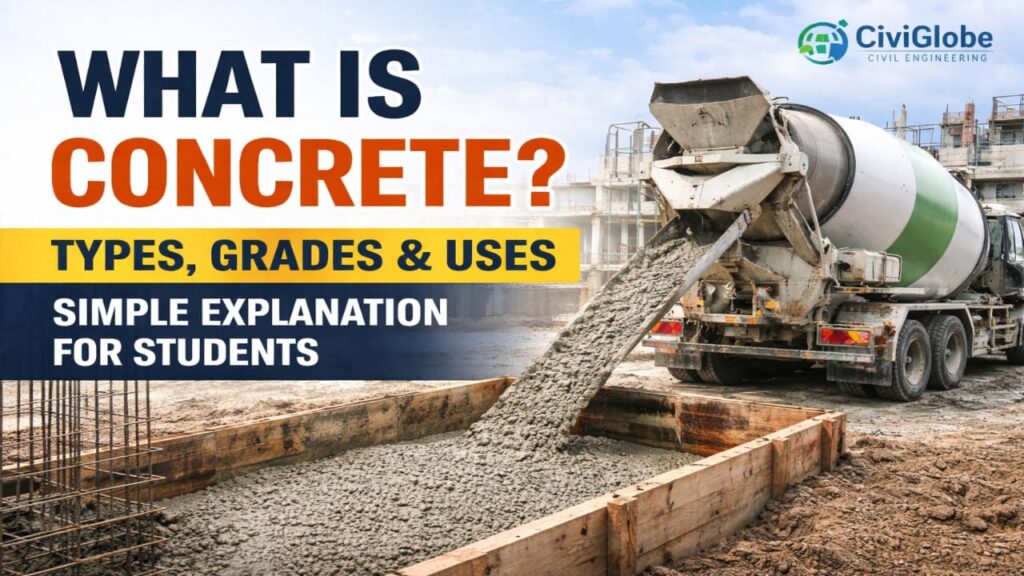
Concrete is one of the most important construction materials used in civil engineering. It is widely used in buildings, bridges, roads, dams, and many other structures because of its strength and durability.
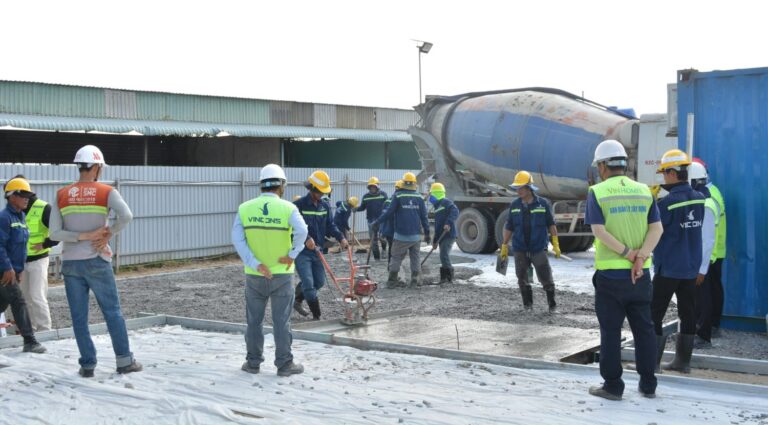
What is Concrete ?
Concrete is a mixture of:
- Cement
- Sand (Fine Aggregate)
- Coarse Aggregate
- Water
When these materials are mixed together, they form a hard and strong mass called concrete
Concrete becomes stronger with time due to a chemical reaction called hydration.
Main Ingredients of Concrete
Cement
Cement acts as a binding material that holds all ingredients together.
Fine Aggregate (Sand)
Sand fills small gaps and improves workability.
Coarse Aggregate
Crushed stone or gravel provides strength to concrete.
Water
Water helps in mixing and starts the hydration process.
Types of Concrete
Concrete without steel reinforcement is called PCC.
Reinforced Cement Concrete (RCC)
Concrete with steel bars is known as RCC.
Ready Mix Concrete (RMC)
Concrete prepared in a batching plant and delivered to the site.
Prestressed Concrete
Concrete in which steel is tensioned before loading.
Grades of Concrete
Grade
Mix Ratio
Common Use
Properties of Concrete
- High compressive strength
- Durable material
- Fire resistant
- Long service life
- Economical construction material
Uses of Concrete
- Buildings
- Bridges
- Roads
- Foundations
- Dams
- Water tanks
- Footpaths
Advantages of Concrete
- Strong and durable
- Easily available materials
- Can be molded into different shapes
- Requires low maintenance
Disadvantages of Concrete
- Weak in tension
- Heavy weight
- Cracks may develop
- Requires proper curing
Conclusion
Concrete is the backbone of modern construction. Its strength, durability, and versatility make it one of the most widely used construction materials in civil engineering projects.
Understanding concrete basics helps students and engineers in practical construction work.
Explore More:
कंक्रीट क्या है? प्रकार, ग्रेड और उपयोग (आसान भाषा में)
कंक्रीट सिविल इंजीनियरिंग में उपयोग होने वाला सबसे महत्वपूर्ण निर्माण सामग्री (Construction Material) है। इसका उपयोग भवन, सड़क, पुल, बांध और कई अन्य निर्माण कार्यों में किया जाता है।
कंक्रीट क्या है?
कंक्रीट निम्नलिखित सामग्री को मिलाकर बनाया जाता है:
- सीमेंट
- बालू (Fine Aggregate)
- गिट्टी (Coarse Aggregate)
- पानी
इन सभी सामग्री को मिलाने पर एक मजबूत और कठोर पदार्थ बनता है जिसे कंक्रीट कहा जाता है।
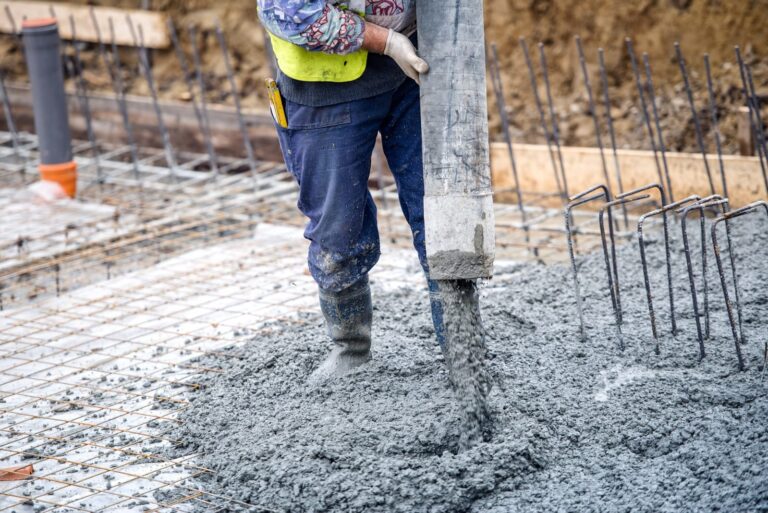
कंक्रीट के मुख्य घटक
सीमेंट
सीमेंट binding material का कार्य करता है।
बालू (Sand)
बालू छोटे खाली स्थानों को भरता है।
गिट्टी (Aggregate)
यह कंक्रीट को मजबूती प्रदान करता है।
पानी
पानी hydration process शुरू करता है।
कंक्रीट के प्रकार
प्लेन सीमेंट कंक्रीट (PCC)
जिस कंक्रीट में steel reinforcement नहीं होता उसे PCC कहते हैं।
आरसीसी (RCC)
जिस कंक्रीट में steel bars का उपयोग होता है उसे RCC कहते हैं।
रेडी मिक्स कंक्रीट (RMC)
बैचिंग प्लांट में तैयार किया गया कंक्रीट।
प्री-स्ट्रेस्ड कंक्रीट
इसमें steel को पहले से tension दिया जाता है।
कंक्रीट के ग्रेड
कंक्रीट का ग्रेड उसकी strength को दर्शाता है।
सामान्य ग्रेड:
- M5
- M10
- M15
- M20
- M25
कंक्रीट के उपयोग
- भवन निर्माण
- सड़क निर्माण
- पुल निर्माण
- नींव (Foundation)
- बांध
- पानी की टंकी
कंक्रीट के गुण
- अधिक मजबूती
- टिकाऊ सामग्री
- आग प्रतिरोधक
- लंबी आयु
निष्कर्ष
कंक्रीट आधुनिक निर्माण कार्यों की रीढ़ माना जाता है। इसकी मजबूती और durability के कारण इसका उपयोग लगभग हर प्रकार के construction work में किया जाता है।
सिविल इंजीनियरिंग छात्रों के लिए कंक्रीट की basic knowledge बहुत महत्वपूर्ण है।
© CiviGlobe. All Rights Reserved.
Empowering Civil Engineering Students Worldwide